Agriculture
Seeing the bigger picture

Agriculture
Industries
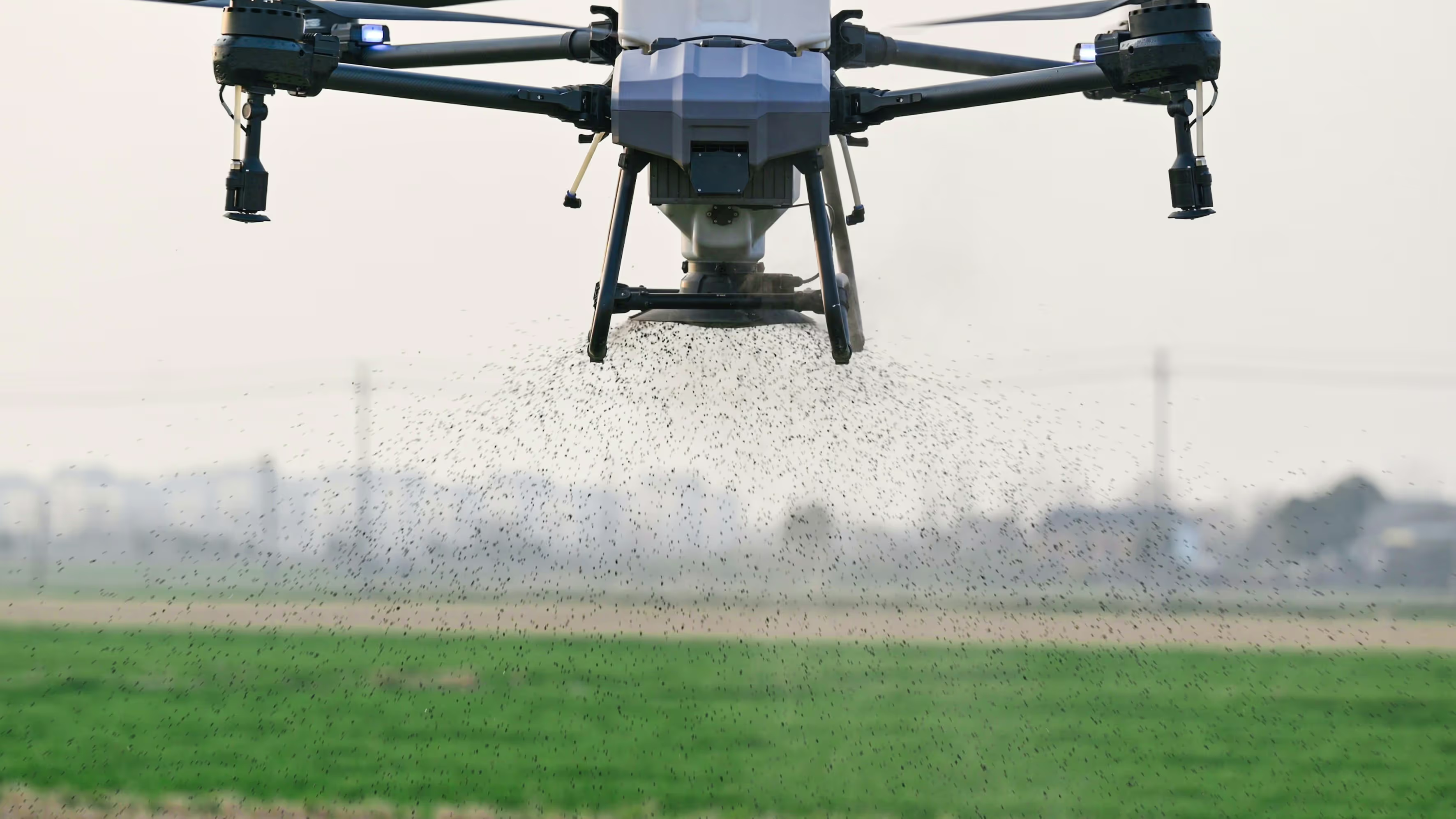
For precision agriculture, farm robotics, crop science, biocontrols and biostimulants, digital agronomy, food supply chain technology, agri-fintech, indoor farming and more.

The technology has, in most categories, already crossed the line of working in the field. The harder line tends to be the one between a successful trial and a farmer who chooses to pay for the product again the season after that, in what has become the most pressured farm economy in a decade.

We work with leadership teams at the point where that gap starts to widen, helping them level the organisation to the quality of the technology, and creating the conditions for long-term growth.
Three key challenges shaping the coming years
A scan of where European agriculture sits at the start of 2026 keeps surfacing the same three questions, in slightly different forms, depending on who you ask.

A precision-ag CEO frames it as the renewal-rate problem. A biocontrols founder frames it as the question of which acquirer is going to call first. A regen-ag platform frames it as the gap between the contract a CPG buyer signed and the cash a farmer has actually received.

Read across the sector, they look less like three separate problems and more like three sides of one set of conditions: farm-level economics, the channel structure between a scale-up and the grower, and the still-unfinished handoff from corporate sustainability ambition to value at the farm gate.
01. From pilot to paid
A January 2026 study from the University of Nebraska looked at eighteen high-profile AgTech shutdowns of 2025, including FarmWise, Ÿnsect, Vertical Future, BharatAgri and Jiva Ag. Thirteen of them, the authors found, came down to what they called the cost-adoption mismatch: the technology worked, the trial data was solid, and the unit economics for the farmer were not quite there. The wider context tends to make that gap more visible than it used to be.

American Farm Bureau and Terrain Ag put U.S. row-crop margins into a third consecutive negative year, with corn revenues down by more than half from the 2022 peak and federal direct payments back at $30 to $44 billion. Equipment makers see the same pattern from the other side: John Deere posted a 16% drop in production and precision-ag sales in the second quarter of 2025, and Q1 2026 farm-equipment market data is at decade lows.

AgFunder's 2026 report shows debt financing has risen to 18.2% of total agrifood funding, the highest share in a decade, as scale-ups gradually move toward Robotics-as-a-Service, outcome-based pricing, embedded credit and parametric insurance. The companies that make that shift over the next twelve months tend to be the ones still standing in 2027.
02. Build, partner, or get acquired
PitchBook's December 2025 analysis of 1,197 venture-backed AgTech companies put the situation plainly: Bayer, Syngenta, Corteva, BASF and Novonesis are repeat acquirers with biologicals named as a strategic priority, which gives scale-ups in that category a buyer pool no other AgTech segment can match, and forces every other category to face a similar question rather earlier than it might want to. Corteva announced a seed-versus-crop-protection split in October 2025 to lean further into biologicals.

Syngenta has already absorbed Valagro, Stoller and Intrinsyx Bio. FMC bought Biophero. Bayer's Climate FieldView covers more than sixty million hectares across twenty-three countries, John Deere Operations Center sits on more than four hundred million connected acres, and AGCO has folded Hummingbird into PTx Trimble.

The route to the European farmer increasingly runs through one of those platforms, and the EU's 2025 Common European Agricultural Data Space and Data Act are now starting to shape whether independents survive on the OEM rails or are eventually absorbed onto them.
03. Scope 3 down to the soil
Roughly 95% of a food company's emissions sit in Scope 3, dominated by upstream agriculture. Nestlé reported around 71 million tonnes of CO2e in 2024 and is now sourcing 27.6% of its key ingredients from regenerative producers. Unilever, Mars, Danone, PepsiCo, ADM, McCain and General Mills have set comparable targets and are increasingly pushing them down to growers. The CSRD, together with the EU Carbon Removals and Carbon Farming Regulation in force as Regulation 2024/3012, gives that demand pull a regulatory backbone for the first time.

The cash flow back to the farmer has not really caught up. Boomitra's CEO described the soil-carbon market last year as having gone through its own Gartner hype cycle, with 2024 sitting in what he called the trough of disillusionment. Indigo Ag has restructured under three rounds of layoffs since 2024. Voluntary credit prices remain well below the hundred-dollar-per-tonne mark Indigo's own team identifies as the catalytic price. The regen-ag platforms that look most likely to survive 2027 are the ones quietly building an audit-grade flow of value from a CPG balance sheet to a farmer's bank account, in agricultural seasons rather than fiscal quarters.
Across European agriculture, scaling tends to look different depending on whether you are in your first season with a new product or your second. The first season has a kind of natural lift to it. The trial plot performs, the early growers are the curious ones, the agronomy teams are willing to spend the time. The second season is where the picture changes. The renewal is a different conversation than the original one was, and most of it happens in places the company is not in the room for.

The farmer is looking at an income statement that has been under pressure for three years now, the dealer has incentives that are not always aligned with the scale-up, and the CPG buyer who promised a regenerative-grain premium upstream is often still working out how that premium reaches the farm gate.
|
What we tend to see is that the work which would change the renewal numbers is rarely the work the company is best set up to do. Repricing the offer so it can be financed against, reshaping the commercial model so the dealer benefits when the farmer benefits, building the kind of evidence base that survives an audit committee at a food company, finding a way to belong in a planting plan that is already drawn up two years ahead. None of that is technological. It is organisational, and it tends to live just below the surface of how an agriculture scale-up is structured during its venture-funded years.

This is roughly the layer that interests us. The work usually happens alongside leadership across at least a couple of seasons, because what matters in this sector tends to be whether a change still holds at renewal time. Most useful first conversations are about where the current renewal numbers actually come from, and which of the underlying moves is most likely to shift them by the time the next planting decisions are made.
Where the work happens

Interconnectivity: AgriTech
A longer read on what’s shaping the sector

The Interconnectivity Series
Drawing Cross-Industries Learnings

Interconnectivity: Agriculture is the long-form version of what we keep coming back to in conversation with operators. Why the cost-adoption gap is widening even as the technology matures, how the route to the European farmer is increasingly running through a small set of platforms, and what a regenerative-agriculture business model starts to look like once the carbon market settles into its real range.
Other industries

Whether you're establishing a new techology or scaling through an inflection point.
We’d love to hear from you.