Biology
Seeing the bigger picture

Biology
Industries
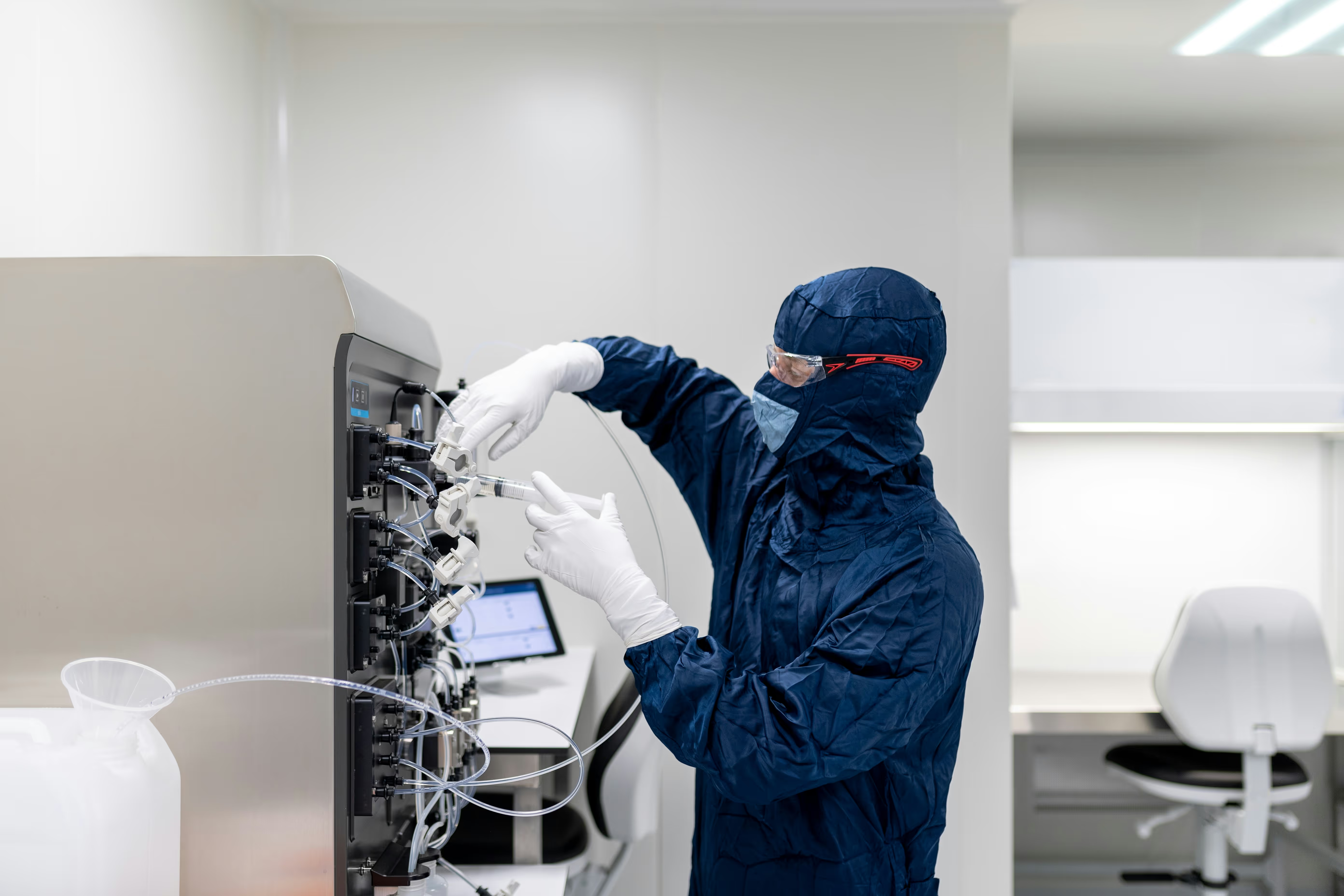
For biotechnology, life sciences, synthetic biology, lab innovation, diagnostics, pharma, and research-driven companies. The scientific milestones tend to arrive faster than the commercial organisation around them.

We work with leadership teams at the point where that gap starts to widen, helping them level the organisation to the quality of the technology, and creating the conditions for long-term growth.
Three key challenges shaping the coming years
The conditions every biotech & life sciences scale-up is now operating inside. Not predictions. Patterns already visible in earnings calls, board packs, and investor letters across the sector.

Each one bites differently depending on where a company sits, but all three are now on the agenda of every CEO trying to scale a proven product.

Three challenges, one underlying story: capital, market-side execution, supply-side execution. A company strong on one and weak on another is the most common shape we see, and the most common reason commercial maturity stalls.
01. Capital has gone selective
39% of biotechs entered 2025 with less than 12 months of cash on hand (EY, Biotech Beyond Borders 2025), the highest reading in six years. The IPO window has narrowed to a haves-and-have-nots market: 8 to 11 biotech IPOs priced in all of 2025 versus 30 in 2024.

Investors now fund discrete value-inflection milestones, not visions. The CEOs raising successfully in 2026 are the ones who have rebuilt their financing narrative around a sequence of binary, defensible milestones, and proved they can hit them on schedule.
02. Approval is no longer the finish line
Only 20 to 30% of first-time biotech launchers exceed launch expectations, versus 40 to 50% for established players (McKinsey Life Sciences, 2024 to 25). The gap between regulatory approval and reimbursed, prescribed, procured volume has widened under the EU Joint Clinical Assessment, IRA price negotiation, MDR/IVDR enforcement and payer consolidation.

In industrial biotech and AgBio the same chasm shows up between offtake agreements and ramped commercial volume.

The work that decides commercial success now starts 24 to 36 months before launch, and most companies still treat it as a post-approval workstream.
03. From first-of-a-kind to Nth-of-a-kind
Europe generates 27% of cleantech patents worldwide, but only 7% of those products reach the market (Cleantech for Iberia, EU Biotech Act consultation). The gap between a flagship plant and a repeatable, bankable, geopolitically resilient manufacturing footprint has become the single largest swing factor on enterprise value.

Sharpened in 2025 to 26 by BIOSECURE, US tariffs on EU and Indian pharma, the EU Critical Medicines Act, and project-finance investor scepticism about novel bioprocesses.

Companies solving this through licensing, project finance and disciplined capacity right-sizing will graduate to category leadership; those funding every successive plant from balance-sheet equity will dilute through 2028.
Across the biotech and life science space, the same pattern keeps appearing. The science moves first. The capital follows. Approval, plant, listing. And then the company finds itself playing two games at once: still being a science company, starting to become a commercial one.

Most of the energy stays with the first. The second is backfilled in fragments.

From the outside that looks coherent. From the inside, the operating reality drifts further from the science by the quarter. The work that closes the drift is rarely glamorous. It sits in the layer underneath. How decisions move from the board to a Friday afternoon. How an offtake on a slide becomes a litre on a truck. How a buyer who has never heard of the company learns about you.

Most companies treat each of those as a separate workstream. The CFO writes the financing narrative, the COO holds the supply, the CCO drives the launch, marketing redesigns the website. The board reads four reports. The market reads one company.

The work is to make it one again. To rebuild the layer between the science and the market as a single piece, deliberately, where it had been built in fragments. To close the distance between what the science has earned and what the rest of the company can actually do.

This is the layer we work on. With leadership, alongside the people already running the company. The first conversation is usually less about a programme and more about understanding the shape of that layer, and where the highest-leverage move actually sits.
Where the work happens

Interconnectivity: Biotech
A longer read on what’s shaping the sector

The Interconnectivity Series
Drawing Cross-Industries Learnings

Some of the thinking behind that work is in Interconnectivity: Biotech. A longer read on the structural shifts underneath the announcements, the patterns we are watching, and where the sector is going next.
Other industries

Whether you're establishing a new techology or scaling through an inflection point.
We’d love to hear from you.